
Sharing the Flowers
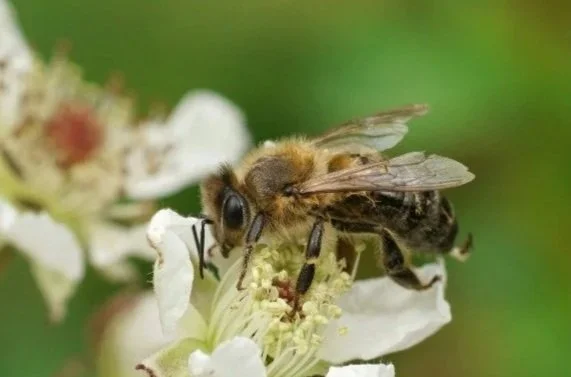
Honeybees have good press. This month, they got a more complicated headline.
Over two years, researchers at Anglia Ruskin University spent 93 hours watching bramble and ivy at five sites around Cambridge, noting every time one pollinator kept another off a flower. Honeybees started most of the trouble. Rivals avoided them in more than a third of encounters on ivy, and in at least one in five honeybee wins, the other insect was physically displaced or chased off. Where honeybee numbers doubled on bramble, bumblebees fell by 14 percent.
The one visitor that pushed back was the ivy bee, a solitary bee first recorded in Britain in 2001.
Lead author Victoria Buckle stresses the point is not to discourage beekeeping — registered beekeepers in Britain have risen from 19,000 in 2010 to 47,000. It is that wild bees need enough flowers, in enough places, that sharing stops being a contest.
Source: Victoria A. Buckle et al., "Honeybees directly outcompete other flower visitors through interference competition on shared resource," Ecological Entomology, 2026. DOI: 10.1111/een.70139. Reported by Phys.org, October 14, 2026, and The Guardian, October 17, 2026.